

Each year, ELPA21 assessments provide important information about how English learners are developing the language skills they need to succeed in school. For educators, these results help guide instruction and support planning. For parents and caregivers, they offer a clear picture of how their student is progressing and where additional support may be helpful. This article walks through what the ELPA21 assessments measure, how and when scores are shared, how to interpret student reports, as well as ways this information can be used to support students both in the classroom and at home.
Overview of ELPA21 Assessments
ELPA21 provides two main types of English language proficiency assessments: a screener and an annual summative. Each assessment has a general version for most English learners and an alternate (Alt) version for English learners with the most significant cognitive disabilities.
The ELPA21 Dynamic Screener and Alt ELPA Screener are administered to students who have been identified as potential English learners. Procedures for identifying students, as well as the availability of specific screeners, may vary by state. Screener results are used to determine whether a student may benefit from English language development services.
Once a student qualifies for English learner services, they participate in either the ELPA21 Summative or the Alt ELPA Summative, depending on their assessment pathway. These assessments are administered annually to measure progress over time.
Both the screener and summative assessments evaluate students across four domains of language: listening, speaking, reading, and writing. Together, these domains reflect how students use English to engage with academic content in real classroom settings.
Relevant resources:
ELPA21 Assessment Process Roadmap – A visual overview of the test administration process.
When and How Scores Are Shared
The Dynamic Screener and Alt ELPA Screener are available year-round to accommodate incoming students. In most cases, results are available shortly after testing is completed if not the same day. However, if additional scoring is required, those results are typically available within a few days following test completion.
The testing window for the ELPA21 Summative and Alt ELPA Summative is determined by each state, but it generally takes place between early February and late March. Summative results are typically available in the spring, often around May, though exact timelines vary by state.
Educators can access score reports through their state’s ELPA21 testing portal. To locate student reports, teachers can navigate to the Test Administrators section, select “Reporting” under the “After Testing” area, and log in using their TIDE credentials. Once logged in, reports can be accessed using the guidance provided in the TIDE User Guide, available in the Resources section of your state’s testing portal. Schools and districts then share Individual Student Reports (ISRs) with families so that both educators and caregivers have access to the same information about student performance.
Making Sense of ELPA21 Scores
Each Individual Student Report (ISR) includes key information about student performance, such as domain or modality outcomes, performance levels, and a proficiency determination of Emerging, Progressing, or Proficient. For summative assessments, reports may also include overall and comprehension scale scores.
While composite scale scores (labeled “Overall” and “Comprehension” on the ISR) are useful for program-level accountability reporting, the most meaningful information for instruction and student support comes from the domain or modality scores and performance levels. These results provide a clearer picture of how a student is performing in each language domain and where additional support may be needed.
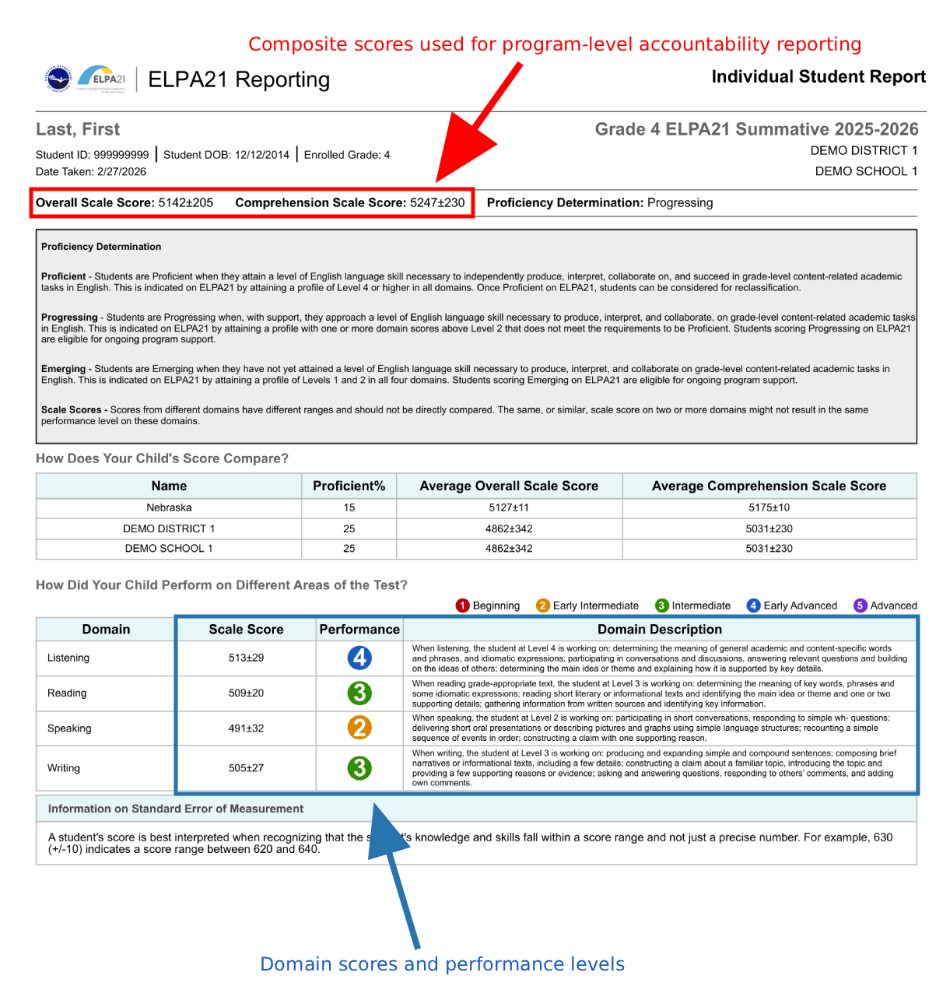
Performance levels are tied to detailed descriptions that explain what students can typically do with language at each stage of development. These descriptions, as outlined in in the ELPA21 Achievement Level Descriptors and Proficiency Level Descriptors, help connect scores to real classroom skills. Achievement Level Descriptors describe what a student has demonstrated, while Proficiency Level Descriptors help guide next steps for instruction. Together, they provide both a snapshot of current performance and a path toward continued language development.
Each ELPA21 assessment provides varying result information, depending on the test. See the sample ISR links below to see how information is shared for each of the assessments mentioned in this post.
Relevant resources:
Sample Dynamic Screener Individual Student Report
Sample Alt ELPA Screener Individual Student Report
Sample ELPA21 Summative Individual Student Report
Sample Alt ELPA Summative Individual Student Report
ELPA21 Achievement Level Descriptors by Domain
ELPA21 Proficiency Level Descriptors by Domain
Alt ELPA Overall Proficiency and Modality Performance Level Descriptors
Alt ELPA Reporting Performance Level Descriptors
Using Scores to Support Students
ELPA21 scores are most useful when considered alongside other information about a student’s learning. As these results reflect performance at a single point in time, they should be interpreted in the context of classroom work, teacher observations, and other assessments.
For educators, domain-level results can highlight patterns in student performance, identify strengths, and point to areas where targeted support or scaffolding may be needed. They also encourage collaboration between English language development specialists and content area teachers, helping ensure that language development is integrated across subjects.
For families and caregivers, the Individual Student Report provides a detailed overview of a student’s progress in English. It can help guide conversations with teachers about strengths, areas for growth, and ways to support learning at home. These discussions can help families better understand where their child is succeeding, where additional support may be needed, and how to encourage continued progress.
Relevant Resources:
ELPA21 Quick Guide to Understanding Student Reports for Educators – A guide for educators that summarizes how ELPA21 assessments are scored and used.
Alt ELPA Quick Guide to Understanding Student Reports for Educators – A guide for educators that summarizes the contents of Alt ELPA score reports, as well as considerations for using and interpreting scores.
Parent Guide to ELPA21 Student Reports – A resource designed to guide parents and caretakers of ELs through the ELPA21 Student Reports, detailing what the scores mean and how the results can be used. Also available in Spanish.
Parent Guide to Alt ELPA Student Reports – A resource designed to guide parents and caretakers of ELs through the Alt ELPA Student Reports, detailing what the scores mean and how the results can be used. Also available in Spanish, Arabic, Chinese, Karen, Portuguese, Marshallese, Russian, Somali, Swahili, and Vietnamese.
A Tool for Growth
ELPA21 assessments are designed to support student growth over time. By focusing on how students use language across listening, speaking, reading, and writing, these assessments provide valuable information that can inform instruction and support meaningful conversations between educators and families. When used thoughtfully, ELPA21 scores help ensure that every English learner has the opportunity to develop the skills needed for success in school and beyond.
For educators seeking additional resources or access to reports, please visit your state’s ELPA21 testing portal. Families and caregivers are encouraged to connect with their student’s teacher or school for more information and guidance on understanding results and supporting learning at home.
Together, these conversations and insights help create a stronger, more supportive path forward for every English learner.